SpringSource tc Server – The logical next step

The time is ripe for lightweight AND enterprise class Java application servers, and Apache Tomcat is the pick of the litter. And now, with SpringSource tc Server, we at SpringSource make it a reality.
If you were familiar with Covalent, and now SpringSource, then you most likely know about ERS (Enterprise Ready Server). ERS is our pre-built, pre-packaged and fully QA-ed distribution of the Apache httpd web server and Apache Tomcat. Included in the distro are also some very useful enhancements, in the form of modules, for Apache, such as PHP, mod_perl and mod_snmp. The somewhat unfortunate aspect of the distro is that, except for mod_jk, the added, extra bits to the Tomcat side were pretty minimal.
tc Server changes this completely.
And we've all seen Tomcat supplant more "traditional" (and heavyweight) JEE servers in numerous environments, but there were always that small group that, even if they didn't need EJB capability (and with Spring, why would anyone need it anyway), the more "enterprise class features" of those servers made them quite useful, and the lack of those features within Tomcat made it very tough to migrate away from them and towards Tomcat.
tc Server changes this completely as well.
tc Server is SpringSource's new software distribution of Tomcat that adds in all those missing enterprise features people want and need. The feature set is pretty impressive:
- Application management
- List applications running in a distributed collection of server instances
- Target, deploy and undeploy applications to distributed server instance
- Start, stop and reload applications running for distributed server instances
- Control web application parameters like caching, JSP behavior, and serving of static content
- Server configuration and management
- Remote configuration control for server instances:
- Configure JDBC Data Sources and connection pools
- Define virtual hosts, access logs and integration with web servers
- Configure JVM server start parameters like Java heap size and garbage collection characteristics
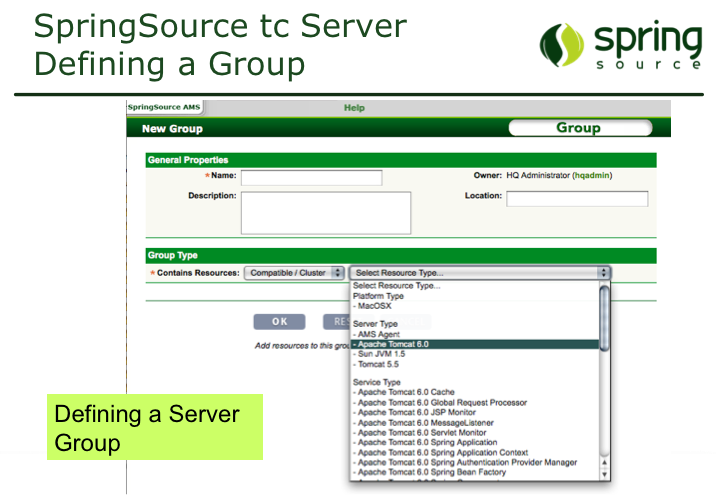
- Define server groups (tc Server or Tomcat instances)
- Advanced server diagnostics
- Application thread lock detection provides warnings when threads compete for restricted resources in a way that would compromise application integrity
- Configurable automatic and on-demand thread and heap dumping for failure and exception analysis
- Thread to URL association for faster diagnosis when analyzing problems with request processing
Included in the above is the ability to do a wide range of administrative tasks from the command-line scripting environment, instead of the GUI, which is perfect for automated tasks and various cronjobs. And, of course, you also get SpringSource's Enterprise support and services as well for the whole package.
tc Server is unique in that it gives you the Tomcat you know, love and trust, but with enterprise capability that you need. Of course, we didn't just stop there. Also in tc Server is a new high-concurrency connection pool that beats the pants off of Tomcat's traditional DBCP and other external solutions. And, in keeping with our long-standing commitment to the Open Source community, this is being donated back to the ASF.
We have lots of plans already for additional diagnostic features to be added with the next major release. We also are working on the next generation of ERS, which adds these enterprise features to the web tier as well for Apache httpd.
From web front end to middleware business logic, SpringSource has your back. So whether you're an old hand in using Apache httpd, Tomcat and Spring, or making that logical (and possibly long overdue) migration, look over all we can do to help.
Click here to learn more about SpringSource tc Server and check out the screencasts of tc Server in action. Or better yet, click on "Download Now!" to take it for a test drive.
Similar Posts
- The cat is out of the bag – tc Server announced
- SpringSource tc Server 6.0.20.A Now Available
- Introducing SpringSource tc Server 2.0
- Optimising and Tuning Apache Tomcat – Part 2
- Optimising and Tuning Apache Tomcat


Adrian Miron says:
Added on April 28th, 2009 at 1:33 pmWhat about a transaction manager?
Ales Jorep says:
Added on April 28th, 2009 at 2:59 pmwhat is the license?
what version of Hyperic does it use?
why do I need to fill out a form to download the bits?
Jim Jagielski (blog author) says:
Added on April 28th, 2009 at 3:09 pmA transaction manager isn't part of tc Server yet… for this first release we've focused on improving what exists, and adding monitoring, management and diagnostic capability. Adding in other extended features to the suite is on the roadmap.
Ryan Wong says:
Added on April 29th, 2009 at 12:18 amI think it's light weight enterprise server…
Since the support of dymanic language make it more flexiable.
Another JBOSS…
So happy to have more choices.. thank tc Team a lot.
Robin Howlett says:
Added on April 30th, 2009 at 1:20 pmIs there any reason I couldn't put tc Server on Amazon EC2?
Christian Dupuis (blog author) says:
Added on May 2nd, 2009 at 4:57 am@Robin: no there is not.
Actually the Roo name voting app (http://cloud.springsource.com/vote/ or http://ec2-79-125-9-62.eu-west-1.compute.amazonaws.com/vote/) which was developed by Ben during the SpringOne keynote was deployed to tc Server running on EC2 using STS. Oh, that sounds a lot like marketing but is just a fact.
Christian
Naaman Lifshitz says:
Added on May 5th, 2009 at 3:41 amHi,
This looks very interesting. We're using Tomcat and our operation-teams' biggest pain-point with it is the lack of management and diagnostics tools.
Could you please clarify the relation between the SpringSource tc-server product and the SpringSource AMS product? Do I need both? Does tc include AMS?
Thanks,
Naaman
Randy MacBlane says:
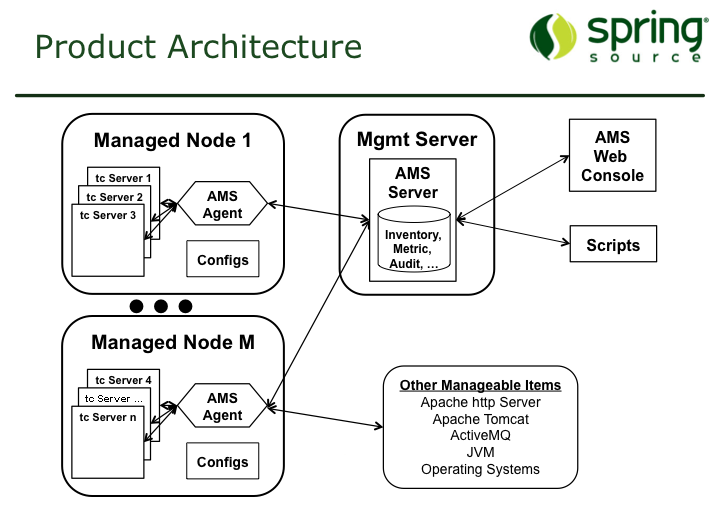
Added on June 1st, 2009 at 10:25 am@Naaman: tc Server is an integrated product bundle. It includes both the runtime container based on Apache Tomcat and AMS (Application Management Suite). AMS is the management component, the diagram Jim included above lays out the role of the AMS Agent and AMS Server in relation to the runtime container (shown as tc Server N in the picture). You'll find the name tc Server used to describe both the bundle and the container runtime, usually you can distinguish the two based on context. I hope that helps.
Regards,
Randy