Get ahead
VMware offers training and certification to turbo-charge your progress.
Learn moreForrester recently described a trend that they refer to as "lean software" in their paper entitled Lean Software Is Agile, Fit-To-Purpose, And Efficient. They state that "lean software is emerging as the antidote to bloatware" and that "the trend toward lean software has been building for years, but the worldwide recession is accelerating it".
Forrester mentions SpringSource as one of four companies at the forefront of the lean software movement. This is due to our leadership within the Spring, Apache, Groovy and Grails communities, as well as our active encouragement, via SpringSource dm Server, of enterprise OSGi as the basis for next-generation application infrastructure.
Since Spring and Apache Tomcat play an important role in lean application infrastructure strategies, I've researched what the job market looks like for developers with Spring and Tomcat skills as compared to EJB, Weblogic, and JBoss skills.
[caption id="attachment_1512" align="aligncenter" width="540" caption="Job Trends for Spring, Tomcat, Weblogic, JBoss, and EJB"]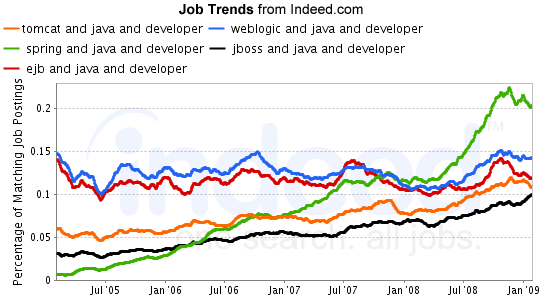 [/caption]
I used Indeed.com to generate the chart above. Indeed.com searches millions of jobs from thousands of job sites and provides a neat service that lets you see job trends for whatever search criteria you may have.
My criteria was Java Developers that have Tomcat, Spring, Weblogic, JBoss, or EJB skills. Click here to go to Indeed.com to see the latest view of my chart above.
The chart nicely illustrates that Spring skills (green line) are in highest demand, well ahead of the others, and has been on a steep incline for the past year. Weblogic skills (blue line) are next and have remained fairly flat over the years. EJB skills (red line) and Tomcat skills (orange line) are neck and neck behind that, with JBoss skills (black line) tracking behind Tomcat but on a similar path.
UPDATED ON MARCH 30 2009:
Let me reiterate that the point of this post is to show that Spring and Tomcat Java developer skills are as easy to find in today's job market as other popular enterprise Java developer skills. With that said, I've been asked why I did not include WebSphere in the chart above. One could argue that WebSphere as a brand is broader than the other items in the search criteria, but I've modified the criteria to include it; the chart now covers Java Developers that have Tomcat, Spring, Weblogic, JBoss, EJB, or WebSphere skills.
[caption id="attachment_1524" align="aligncenter" width="540" caption="Job Postings for Tomcat, Spring, Weblogic, JBoss, EJB, and WebSphere"]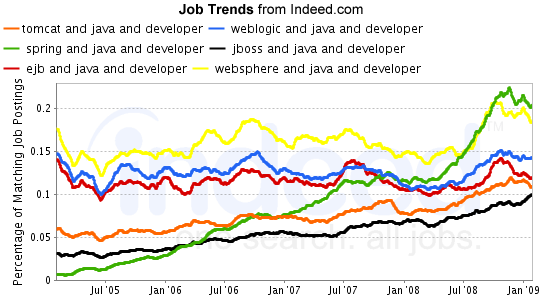 [/caption]
Click here to go to Indeed.com to see the latest view of the chart above.
[/caption]
Click here to go to Indeed.com to see the latest view of the chart above.
Conclusions? More and more companies are looking at lean application infrastructure to help them remain competitive, and the difficult economy is only accelerating this trend. These businesses not only need to feel comfortable with the technologies they embrace, but they also need to make sure they can easily find people experienced with the technologies.
Since I work at SpringSource, I have a keen interest in the health and vibrancy of both Spring and Tomcat. I'm happy to see that Spring and Tomcat are doing so well in the job market for Java developers. This fact will help my customers feel more comfortable choosing SpringSource Enterprise and SpringSource tc Server to power their applications.
Credits: I'd like to thank Indeed.com for providing this valuable job trends service on their website. It provides a great way to understand the past and current directions of whatever type of job you may be interested in.

VMware offers training and certification to turbo-charge your progress.
Learn moreTanzu Spring Runtime offers support and binaries for OpenJDK™, Spring, and Apache Tomcat® in one simple subscription.
Learn moreCheck out all the upcoming events in the Spring community.
View all